Emulations of legacy music equipment.
Lemus is an independent project that emulates electronic music equipment no longer in production: synthesizers, drum machines and effects. Its purpose is to preserve how these machines work and how they sound, by documenting their hardware and recreating it in software. Each machine is released as its own plugin.
Being playable is how the documentation is tested: an emulation that is right sounds right.
About Lemus
Lemus is an independent project. Its plugins are free. It is not affiliated with the makers of the equipment it emulates.
How a machine is emulated:
Firmware
If a machine has a CPU, its original program runs unmodified on an emulated processor. The ROM image is not included. Lemus identifies it by SHA1.
Circuits
Analog circuits are modelled component by component from the manufacturer's schematic and service notes. Each block is compared with a SPICE simulation of the same circuit, with typical part values and at the limits of their tolerance.
Calibration
The schematic doesn't fix every value. Trimmer settings, transistor gain and potentiometer taper are fitted to recordings of real units, within each part's tolerance. Units differ, so the trimmers are adjustable to match a particular unit.
Supported machines
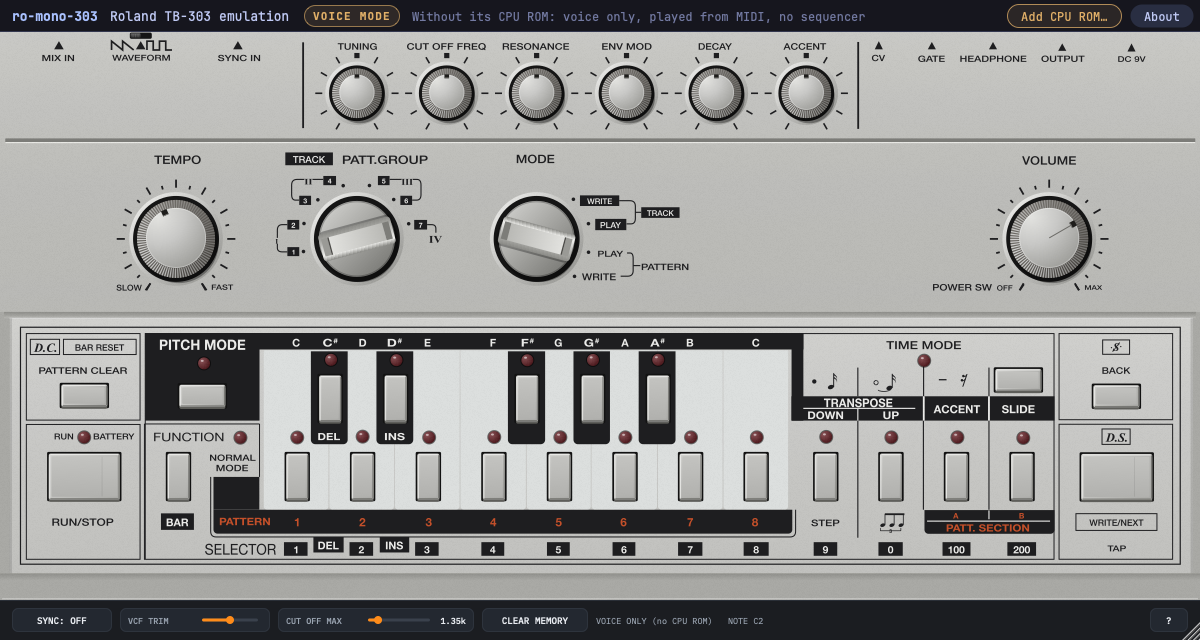
Each machine is a separate plugin. A plugin's name is its maker, its type and its model: ro-mono-303 is a Roland monophonic synthesizer, model 303.
ROM images
Lemus does not include ROM images. A ROM image holds a machine's original program, which is copyrighted, and it can't be lawfully distributed without the copyright holder's permission. No part of any original program is included in Lemus. The ROM image must be provided by the user.
A machine with a CPU needs its ROM image to run its firmware. Put the image in the ROM folder, where it is identified by SHA1. Some machines also have a voice mode for when the ROM is missing. The plugin list shows which.
Complete emulation
The original firmware runs, and the machine behaves as the hardware does.
Fallback, some machines
On some machines the sound circuit doesn't depend on the CPU. Their voice can be played over MIDI without the ROM, but anything the CPU does, such as a sequencer, is unavailable. Adding the ROM later restores the complete machine in an existing session.
Not running
A machine without a voice mode doesn't run until its ROM image is in place.
Panel artwork
Lemus draws each panel itself, from measured photographs, with legends, lines and controls placed to within about 0.3 mm.
The makers' logos and model names are trademarks of their owners. Lemus has no permission to use them, so it doesn't include them, and their places on the panel are left blank.
Users can provide their own artwork for these places. Each plugin installs an empty SVG artwork file in the ROM folder, with a commented-out slot for each mark. Artwork placed in a slot, with the slot's comment markers removed, is drawn on the panel. Until then the file draws nothing.
ROMs/
  tb303.zip      ROM image
  tb303.svg      artwork file, installed empty